How to Calculate Percentage
Percentages are everywhere. Any test score, a discount on a purchase, a bump in your pay, a business profit margin or even how many people are in attendance can be expressed as a percentage. It is a relatively advanced idea, but a very basic one: What is the relationship between two quantities? From then on, it is easier to make percentage calculations.
The Core Idea Behind Percentage
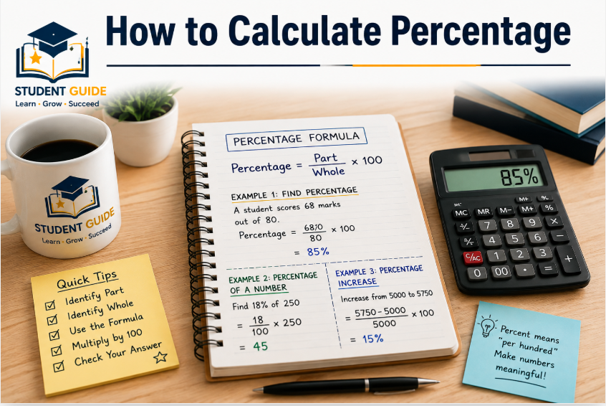
The term percentage can be replaced by the words “per hundred.” Therefore, 40% means 40 out of 100, while 7% means 7 out of every 100. The formula for the standard is:
Percentage = (Part ÷ Whole) × 100
Part is the quantity being measured and whole is the total quantity. For instance, if a learner gets 68 marks in a total of 80 marks, then it’s 68/80:
(68 ÷ 80) × 100 = 85%
The student’s result is therefore 85%.
Three Percentage Questions You Should Know
There are three types of percentage problems. The first thing to do is to determine what percentage one number is of the other. Secondly, you might need to discover a certain percentage of a number. Thirdly, you might have to determine the change in value.
Finding a Percentage from Two Values
How many students do not attend the workshop, if there are 45 students in a class and 36 students go to the workshop? To determine the percentage of the attendance:
(36 ÷ 45) × 100 = 80%
So, 80% of the students attended.
Finding a Percentage of a Number
To calculate 18% of 250, you can either convert 18% to a decimal or turn it into a fraction:
(18 ÷ 100) × 250 = 45
Therefore, 18% of 250 is 45.
Measuring an Increase
When a value rises, use:
Percentage Increase = ((New Value − Original Value) ÷ Original Value) × 100
The new allowance is 5,750 and the old allowance was 5,000, how much more is the monthly allowance:
(750 ÷ 5,000) × 100 = 15%
The allowance increased by 15%.
Measuring a Decrease
For a reduction, use:
Percentage Decrease = ((Original Value − New Value) ÷ Original Value) × 100
If a product falls from 3,000 to 2,400, the decrease is 600:
(600 ÷ 3,000) × 100 = 20%
The price has decreased by 20%.
A Quick Look at Discounts
Percentage calculations are especially useful when you’re out shopping. The price of a jacket is $6,000 and is discounted 25%. A jacket is 25% off, and its price is $6,000. First calculate the discount:
(25 ÷ 100) × 6,000 = 1,500
Then subtract the discount from the original price:
6,000 − 1,500 = 4,500
The customer therefore pays 4,500.
Using Percentages in Academic Results
Percentages are common when interpreting test scores. If the total marks of the paper is 750 and a student gets 615 marks, then the ratio of marks obtained by the student to the total marks in the paper is:
(615 ÷ 750) × 100 = 82%
The student has achieved 82%. How percentages, grades and GPA relate to each other will differ from school to school, but students should consult the grading policy before making a comparison.
Percentage, Decimal, and Fraction: The Connection
The three forms are all expressions of the same mathematical relationship. For example:
75% = 75/100 = 3/4 = 0.75
To convert a percentage to a decimal fraction divide by 100. To change decimals to percentages multiply by 100. Write percentages as fractions: Put the percentage over 100 and simplify the fraction to its lowest terms.
Mistakes That Can Change the Answer
The most common error occurs when the wrong whole is selected. The denominator of the reference total should be in the denominator. Often the error made is to use a percentage increase rather than a percentage point increase. Rounding error will also be an issue if rounding is performed too early, particularly if several calculations are carried out at the same time.
As you select a response, reflect on: What is a full answer? What is the part? When working with percentages are you calculating a proportion, increase, decrease or a percentage of a number?
Why This Skill Matters
Percent is not a just an examination subject. It aids in the understanding and decision-making process. Whether comparing academic achievement, a discount, comparing costs, studying survey results, or comparing business figures, percentages quantify and make comparisons meaningful.
Final Takeaway
The key formula to recall is:
Percentage = (Part ÷ Whole) × 100
Identify what you’re comparing, then select the right calculation. When we start solving percentage problems, it becomes more practical and less the formula. This knowledge will be important in order to use the concept of percentage in academic activities and in daily life.