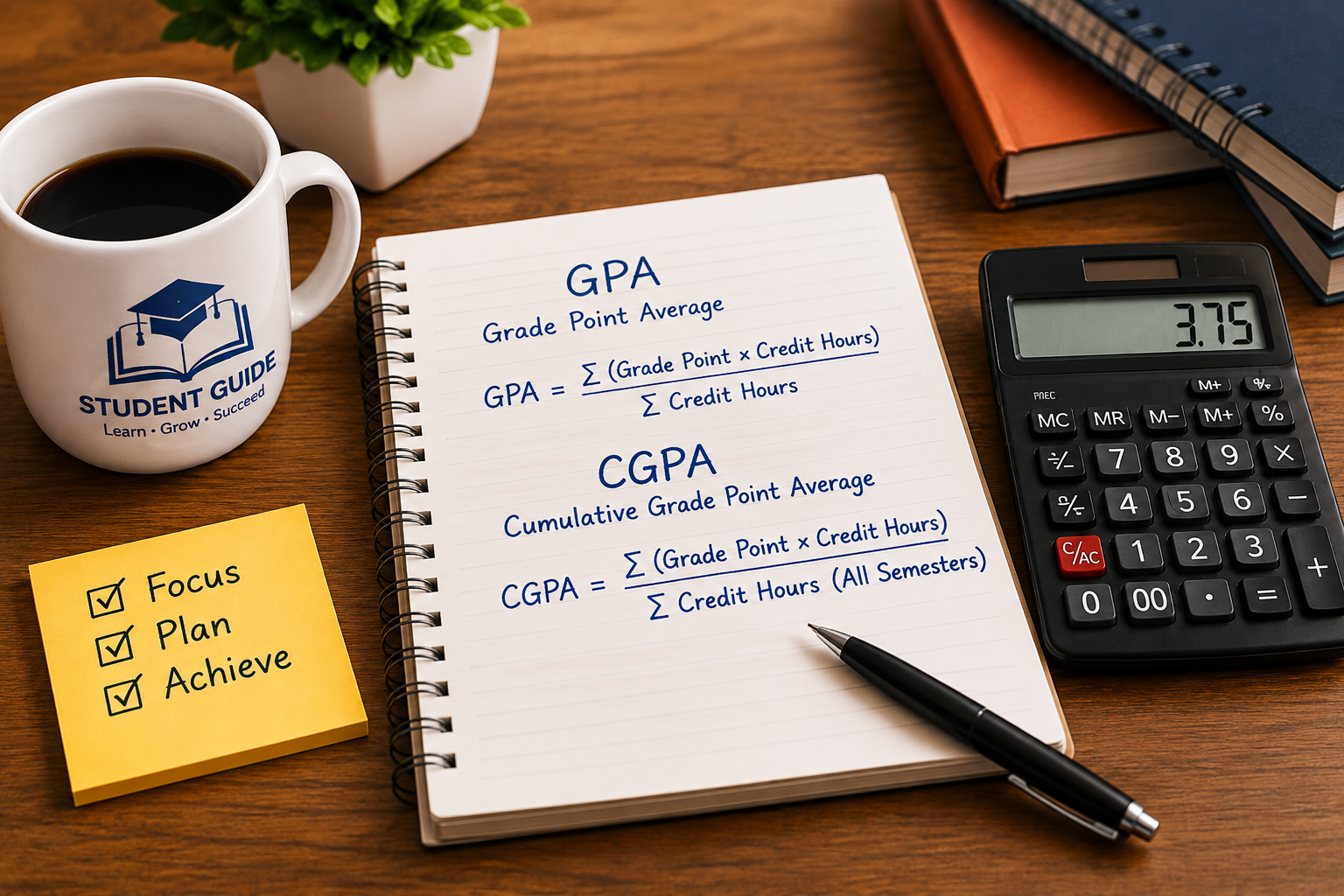
GPA and CGPA may appear a bit elusive, but both are simple ways of measuring academic performance. They can be useful for considering progress, for any admissions applications or for future studies.
What Is GPA?
GPA, or Grade Point Average, is a measure of your grade work for a semester or term. Most universities use the 4.0 grading system, with the exception of those that use a different one. A number is assigned to each letter grade and the credit hours for the course are added together.
The basic formula is:
GPA = Total Grade Points ÷ Total Credit Hours
Grade points for a single course will be the grade point multiplied by the credit hours. Therefore, an “A” grade in a 3-credit course will count as 12 credit points.
How to Calculate GPA Step by Step
List all courses, determine each course grade level, add grade point for each course (grade level x credit hours), add all grade points and divide by the total credit hours.
What would your GPA be for three courses: 3 credit courses with A (4.0); 3 credit courses with B (3.0); 2 credit courses with A (4.0)? What is the 3-course GPA of the following three courses: A (4.0), 3 course (3.0), 2 course (4.0)? Your calculation is:
(4.0 × 3) + (3.0 × 3) + (4.0 × 2) = 33
You completed eight credit hours, so GPA = 33 ÷ 8 = 4.125. If your institution adopts a grading system with a maximum score of 4.0, apply the rules of your grade system.
What Is CGPA?
Cumulative Grade Point Average (CGPA) is based on the performance in a number of semesters (whole degree). CGPA provides a holistic idea about your overall performance.
The formula is:
CGPA = Total Grade Points Across All Semesters ÷ Total Credit Hours Across All Semesters
Total weighted grade points and credit hours for each semester attended. If the credit loads vary, this is likely to be a false picture if an average of semester GPAs is used.
If for example, during the first semester the student earned 15 credit hours and a GPA of 3.20 and during the second semester the student earned 18 credit hours and a GPA of 3.60. The calculation is:
(3.20 × 15) + (3.60 × 18) = 112.8
Total credit hours = 33
CGPA = 112.8 ÷ 33 = 3.42
GPA vs. CGPA: What Is the Difference?
There’s an easy difference. GPA is the academic performance of a semester and CGPA is the academic performance of several academic periods. Previous grades are included in the CGPA calculation but the rate of change is less than in GPA, which can vary significantly from semester to semester.
Why GPA and CGPA Matter
These numbers can be important to academic achievement, academic scholarships, internships, exchange programs and admission to programs. Academic performance can also be used as a criterion for admission to entry level positions.
But GPA and CGPA does not reflect your academic life. Research, communication, projects, leadership and practical skills can have an impact on other opportunities.
Common Mistakes to Avoid
A common mistake is that students might not keep track of the number of credit hours and consider all courses as having equal weight. The latter is the use of a grading scale different from your university’s grading scale. The students may also calculate the CGPA by averaging the GPAs of each semester (which may not be accurate due to the difference between the credits of each semester).
Before making a big calculation, please review your institution’s grading policy. There are some universities that give + or – grade, some that allow retakes on courses, and some have a conversion procedure.
Final Thoughts
Calculating GPA and CGPA becomes much easier, by focusing on two major aspects: Grade Points and Credit Hours. GPA gives an overall view of a particular semester or session whereas CGPA reflects the overall trend of your academic performance. Once you have learned the formulas, you’ll be able to see how far you’ve progressed, and know exactly what to do to get better. Remember, academic numbers are a guideline, not a rule when it comes to potential. Follow them, learn from them and become more knowledgeable and skillful in each semester so as to realize yourself goal.
FAQs
1. What is the difference between GPA and CGPA?
GPA is used to rate a student’s performance in a given semester or term, whereas CGPA is used to rate the cumulative performance of a student for a number of semesters or degrees. While changes in GPA can be significant from semester to semester, CGPA shows the overall pattern.
2. How is GPA calculated?
The grades from each course are multiplied by the number of credits for the course, all the grade points for the courses are added together and the resulting total is divided by the number of course credits. The general guideline is that GPA = Total Grade Points / Total Credit Hours.
3. How is CGPA calculated?
The CGPA is obtained by dividing total weighted grade points by total credit hours of all completed semesters. CGPA is calculated as Total Grade Points Across All Semesters divided by Total Credit Hours Across All Semesters. This is a more precise method if semesters have unequal credit values.
4. Can I calculate CGPA by simply averaging my semester GPAs?
Not always. The sum of the GPAs of the semesters and the number of the semesters may not yield an accurate GPA if they have varying numbers of credit hours. A weighted grade-point average provides a more accurate CGPA based on weighted grade points and credit hours.
5. Why are credit hours important when calculating GPA and CGPA?
The weight of a course is determined by the number of credit hours. It’s important to note that a three-credit course will impact GPA more than a one-credit course. Some credit hours may be subjected to different treatment, and can create an inaccurate academic average if they did not keep the same weight and were not treated equally.
6. Does a GPA or CGPA fully represent a student’s academic potential?
While both the GPA and CGPA help to measure academic performance, they are not comprehensive measures of a student’s capabilities. Research experience, communication, leadership, projects, practical skills and other accomplishments can also play a big role in academic and graduate career opportunities.